
Criminal Procedure – 4th Amendment Analysis for Searches and Seizures of Persons and Evidence
A Helpful Flowchart to Avoid MEE and MBE Mistakes!

The principles and surrounding law pertaining to the 4th Amendment are some of the most heavily tested rules of Crim Pro on the exam. The below flowchart provides an easy way for us to memorize whether a government agent’s seizure of a person was lawful or not and then whether a search and seizure of evidence would be deemed lawful or not. Underneath this chart, I provide the same information in text format for those who prefer the rules presented in this fashion.
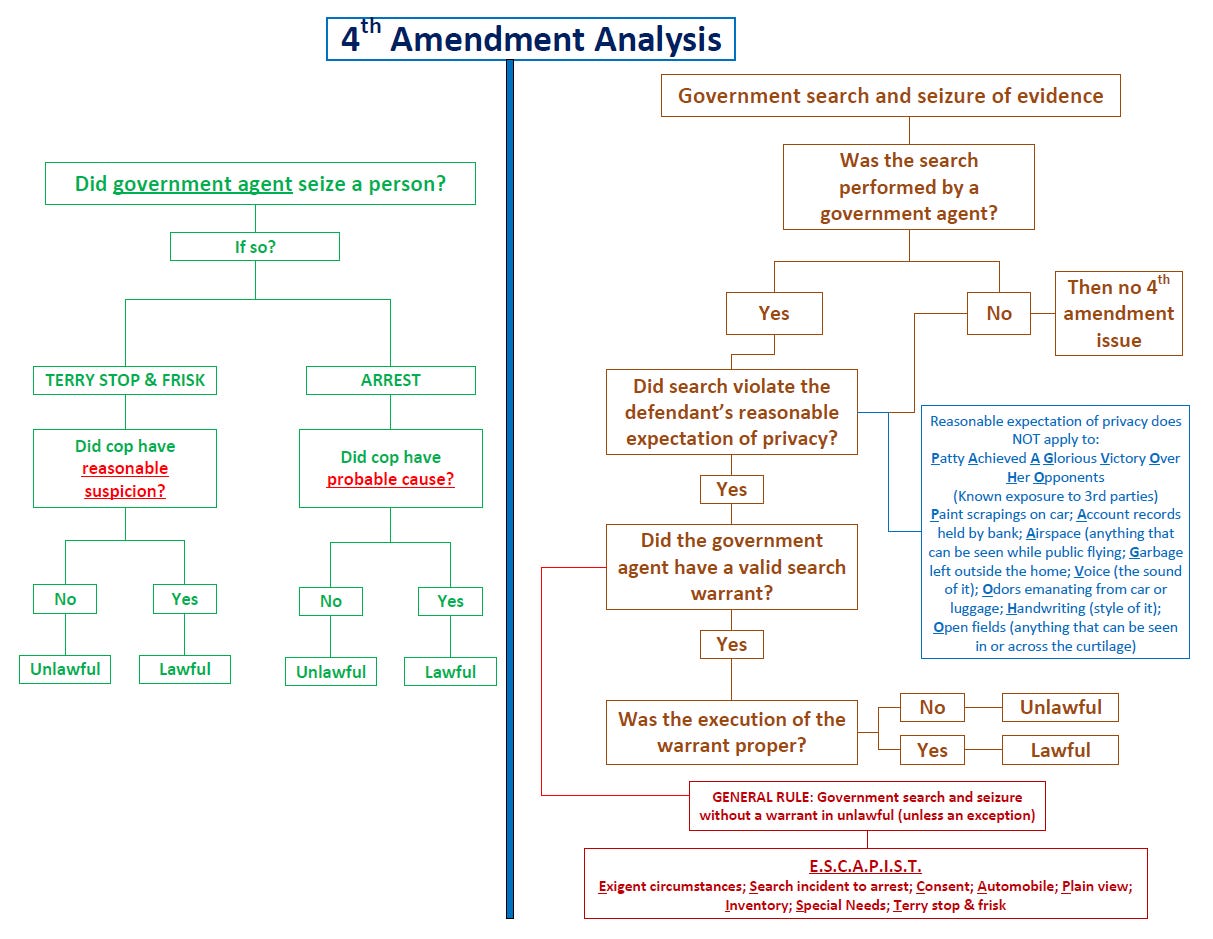
· Did a government agent seize a person? Yes?
For a Terry Stop and Frisk?
With reasonable suspicion? Stop is Lawful.
With NO reasonable suspicion? Stop is Unlawful.
For an Arrest?
With probable cause? Stop is Lawful.
With NO probable cause? Stop is Unlawful.
For a Government Search and Seizure of Evidence:
Was the search performed by a government agent?
No? NO 4th Amendment Issue!
Yes?
Did the search violate the defendant’s reasonable expectation of privacy?
No? NO 4th Amendment Issue!
NOTE – A reasonable expectation of privacy does NOT apply to items of known exposure to third parties including:
Paint scrapings on a car;
Account records held by a bank;
Airspace (anything that can be seen while publicly and legally flying overhead);
Garbage left outside one’s home;
The sound of one’s voice;
Odors emanating from car or luggage;
The style of one’s handwriting;
Open fields.
Yes? Did the Government have a valid search warrant?
Yes? Was the execution of the warrant proper?
Yes? Lawful seizure.
No? Unlawful seizure.
No? Unlawful! Unless an exception applies.
Exceptions include:
Mnemonic of ESCAPIST:
Exigent Circumstances;
Search Incident to a Lawful Arrest;
Consent;
Automobile searches;
Palin view;
Inventory search;
Special needs search;
Terry Stop and Frisk.
If we can apply the flowchart contents in an instance where we are faced with an MBE question and/or an MEE issue dealing with a government search and/or seizure we will avoid some of the foolish mistakes made with these relatively easy questions.